

Gemstone
Sodalite
Origin: Bolivia
Care instructions
Use a soft damp cloth for regular care and dry immediately. Avoid impact, standing water, abrasive products, and acidic cleaners. Natural markings, veining, and tonal variation are characteristic of the stone.
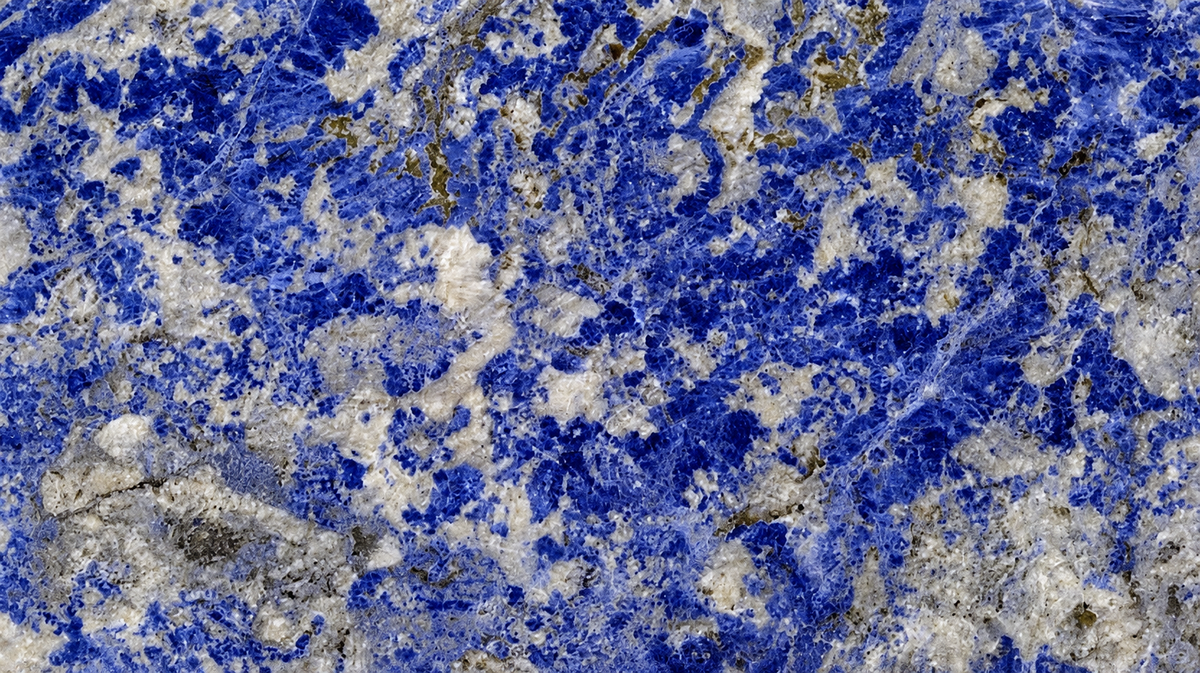
Our Sodalite comes from the Cerro Sapo region in the Bolivian Andes, where the deep blue mineral occurs alongside lighter minerals such as ankerite and baryte. This natural combination creates the characteristic contrast of rich blue with white and cream-colored areas, giving each section of stone its own individual pattern.
Bolivian Sodalite forms within the unusual alkaline geological complex of Cerro Sapo, where sodalite-bearing veins developed in association with nepheline syenite and carbonatite. As the minerals crystallized under changing geological conditions, blue sodalite formed alongside the lighter mineral components that remain visible throughout the stone today. The resulting structure ranges from concentrated areas of deep blue to irregular veins and patches of cream and white.
The history of Sodalite in the Andes reaches back long before modern mining. Archaeological finds show that the blue stone was worked in pre-Inca times and fashioned into beads and ornamental objects. The stone therefore connects a distinctive geological formation with a history of craftsmanship that extends back more than a millennium. Today, Bolivian Sodalite continues to be used both as a gemstone and as a decorative stone, valued for its deep blue color and naturally contrasting mineral structure.
Bolivian Sodalite forms within the unusual alkaline geological complex of Cerro Sapo, where sodalite-bearing veins developed in association with nepheline syenite and carbonatite. As the minerals crystallized under changing geological conditions, blue sodalite formed alongside the lighter mineral components that remain visible throughout the stone today. The resulting structure ranges from concentrated areas of deep blue to irregular veins and patches of cream and white.
The history of Sodalite in the Andes reaches back long before modern mining. Archaeological finds show that the blue stone was worked in pre-Inca times and fashioned into beads and ornamental objects. The stone therefore connects a distinctive geological formation with a history of craftsmanship that extends back more than a millennium. Today, Bolivian Sodalite continues to be used both as a gemstone and as a decorative stone, valued for its deep blue color and naturally contrasting mineral structure.