

Gemstone
Labradorite
Origin: Madagascar
Care instructions
Clean with a soft damp cloth and dry immediately. Avoid acidic cleaners, abrasive materials, harsh chemicals and prolonged contact with liquids. Natural variation, inclusions, and tonal change are part of the material character.
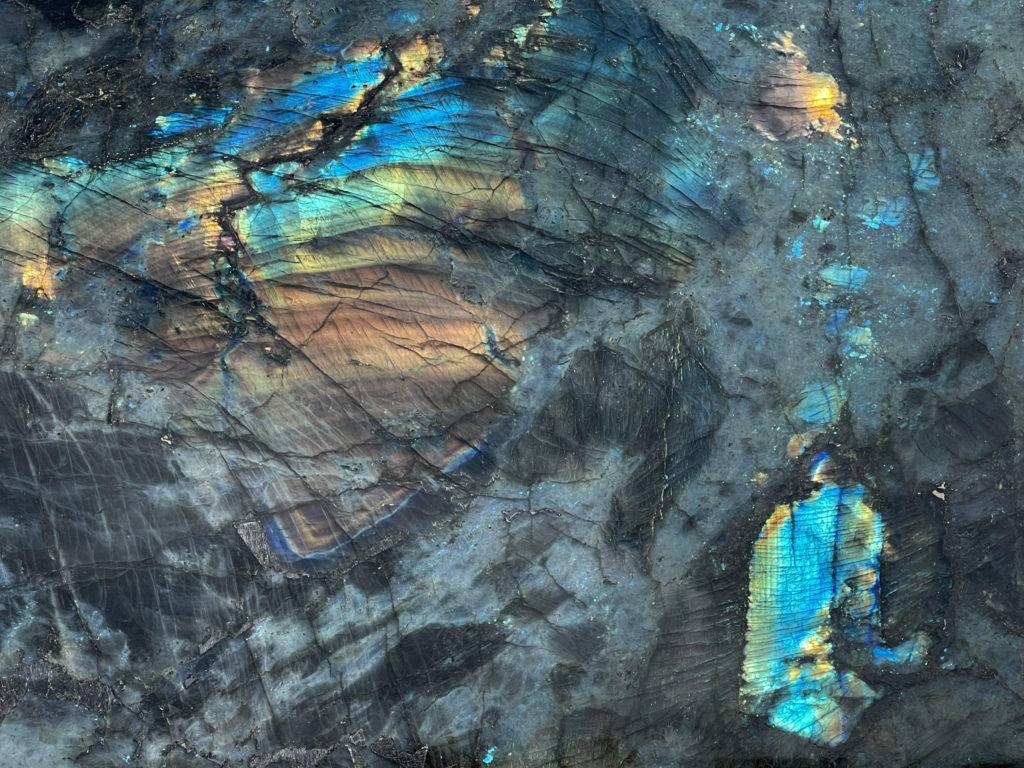
Our Labradorite comes from Madagascar, known for material with a particularly expressive play of color. At first glance, the stone can appear remarkably understated, with base tones ranging from dark green, grey and brown to almost black. As light moves across its surface, flashes of blue, green, gold and violet emerge and disappear depending on the viewing angle. This distinctive optical phenomenon is known as labradorescence.
Labradorite belongs to the feldspar mineral group and forms as minerals crystallize during the slow cooling of igneous rock. Within the stone, extremely fine internal layers develop. When light enters and interacts with these layers, it is reflected and separated into different wavelengths, creating the shifting colors for which Labradorite is known. The effect varies naturally from one section of stone to another, giving every piece its own individual appearance.
The stone takes its name from Labrador in Canada, where Labradorite was first documented in 1770 after being identified on Paul Island, off the coast of Labrador. Its remarkable iridescence quickly became one of its defining characteristics. Labradorite has since been identified in deposits around the world, with Madagascar becoming particularly known for highly iridescent material. Today, the stone continues to be valued for the contrast between its restrained surface and the unexpected colors revealed by light.
Labradorite belongs to the feldspar mineral group and forms as minerals crystallize during the slow cooling of igneous rock. Within the stone, extremely fine internal layers develop. When light enters and interacts with these layers, it is reflected and separated into different wavelengths, creating the shifting colors for which Labradorite is known. The effect varies naturally from one section of stone to another, giving every piece its own individual appearance.
The stone takes its name from Labrador in Canada, where Labradorite was first documented in 1770 after being identified on Paul Island, off the coast of Labrador. Its remarkable iridescence quickly became one of its defining characteristics. Labradorite has since been identified in deposits around the world, with Madagascar becoming particularly known for highly iridescent material. Today, the stone continues to be valued for the contrast between its restrained surface and the unexpected colors revealed by light.